Any Other Gospel

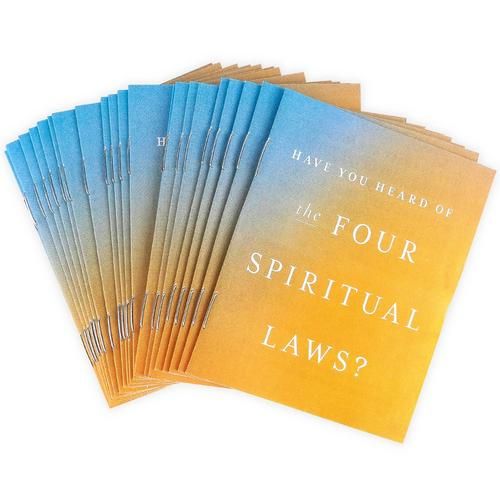
The Four Spiritual Laws is likely the most popular gospel tract ever written, the most widely distributed of all time, likely over 2.5 billion. It summarizes basic Gospel truths in four simple points:

  1. God loves you and has a wonderful plan for your life. (Jn 3:16; 10:10)
  2. Man is sinful and separated from God. (Ro 3:23; 6:23)
  3. Jesus Christ is God’s only provision for man’s sin. (Ro 5:8; 1Co 15:3-6; Jn 14:6)
  4. We must individually receive Jesus Christ as Savior and Lord. (Jn 1:12; Ep 2:8-9; Re 3:20)

The tract ends with instructions to “receive Christ” by praying a prayer inviting Him into our heart and committing our life to follow Him, assuring us that if we prayed sincerely, we’re now a child of God regardless how we feel.

While each of these four laws is scriptural on the surface, the actual gospel (or good news) presented in this tract — that if we sincerely ask Christ to forgive our sins and come into our heart and save us, that He will — is not. In fact, it is so vastly different from the Biblical reality it amounts to another gospel (2Co 11:4), a false one. It distorts each of these four spiritual principles and encourages an unbiblical response to them.

While the Bible equates receiving Christ with supernatural rest in the Person and finished work of Christ (He 4:3), this false gospel substitutes a mechanical “sinner’s prayer” technique, and also incorrectly defines every key term: repentancesin and faith. It even explicitly normalizes unbelief by discounting the primary evidence of saving faith: assurance of salvation. (1Th 1:5)

The true Gospel is that Christ delivers those who believe on Him from their violations of His law: Torah. (Mt 1:21, 1Jn 3:4) As we trust Him to do so, He saves us from both the penalty we deserve for breaking Torah by dying for us in our place (Is 53:11), and He also saves us from our tendency to break Torah (Ro 6:14) by writing His laws into our minds and hearts. (He 8:10)

When God changes how we think about deliberately breaking Torah and gives us hearts fully submitted to God (repentance: 2Ti 2:25), and reveals to us that His blood has paid our sin debt in full (faith: Ro 3:25), that Father God has now made His Son Jesus Christ to be sin for us (2Co 5:21), we cannot rightly pray and ask Jesus to save us… because we will confidently know that He already has.

This supernatural knowledge will be accompanied by several significant changes within our hearts: we will love Jesus Christ (1Co 16:22); we will start obeying Torah (1Jn 3:9); pleasing God will become the most important thing to us; we will be willing to forsake anything and everything to follow Him. (Lk 14:33)

So long as any of these evidences of saving faith are not present, no one should be assured of salvation (2Co 13:5); rather, we should diligently continue seeking God, asking Him to reveal Himself to us and give us repentance to acknowledge and rest in the truth (2Ti 2:25) until He gives us faith and a new heart, assuring us of our eternal safety. (He 11:6) We should strive to enter the narrow gate into salvation (Lk 13:24), examining ourselves and systematically proving it to ourselves (2Co 13:5), diligently making our calling and election sure (2Pe 1:10), until doubting our salvation the tiniest bit is entirely foreign to us. (1Jn 5:13)

But this tract, rather than encouraging us to wait on God until we experience this deep, supernatural, inward change in what we are trusting in as the basis for our salvation, shifting entirely away from dependence on ourselves and our own works to the finished work of Christ — which is the only act that can save us, and experience how this change in our faith system is transforming our hearts to love and obey Christ from the moment this first appears within us, we are told we are now a child of God even if our beliefs about Christ and salvation have not changed and we feel no different since we started reading the tract.

In other words, this gospel assures us of eternal life simply because we asked for it, regardless what we actually believe or how we feel. This teaches us to depend on the act of praying sinner’s prayer for our salvation rather than on Christ Himself and His finished work, and it positively affirms the reality of our salvation even if we have no evidence of this faith at all, no true faith in Christ.

So, what this tract is actually doing is inoculating us against the true Gospel by offering us false hope of Heaven based upon our own work: our act of sincerely praying the sinner’s prayer.

This framing of the Gospel implies Christ has died for everyone but that His death saves no one, that believing on and resting in the atonement of Christ is insufficient, that faith does not save us, that we must do something else besides believe.

The message effectively presents Christ’s sacrifice as ineffectual: not actually saving us as we believe, only making it possible for us to save ourselves by deciding to pray the sinner’s prayer and “receive Christ”. So, in trying to distill the Gospel for us, it explicitly denies Christ’s atonement as the divine act which saves us when we rightly receive Christ and believe on Him. (Jn 1:12-13)

While presenting Jesus as the only bridge to God, this false gospel lies to us about how we cross this bridge; it deceives us about how Christ truly accomplishes our salvation: by dying for us as we believe in Him and manifesting the reality of this faith in our hearts. It leads us up the path to the narrow gate (Mt 7:14), offers us a cheap substitute for entering in through this gate, and then turns us away, assuring us we have entered in and that all will be well as we continue on down the broad road to destruction. (13)

There is only one true Gospel; trusting any other gives false hope of Heaven, which may be the most dreadful possible state we can ever be in — thinking we’re eternally safe when we’re not. God’s curse upon those who willfully participate in such deception is evidently just. (Ga 1:8-9)

After so many millions have been misled by this shallow, evangelistic travesty, is it any wonder Christ Himself prophesies of the many who will come to Him expecting open arms, only to hear Him say, “I never knew you. Depart from me, you who practice lawlessness.” (Mt 7:22-23)

articles    blog

Are There Few?

When Christ was asked, “Are there few that be saved?” (Lk 13:23), He didn’t answer directly; perhaps the question is too vague to answer meaningfully with a simple Yes or No.

The question is indeed fascinating, seeking a ball-park percentage of how many people will ultimately find eternal life. Why is this relevant? If the percentage is relatively high, say 7 or 8 out of 10, we might relax and coast a bit, thinking as long as we’re better than those around us, we’re good to go. But if the odds are 1 in 10,000 it’s another matter entirely, that’s a wake-up call to diligently make our election sure (2Pe 1:10), to work out our own salvation with fear and trembling. (Php 2:12)

Christ’s reply is indeed sobering: “Strive to enter in at the strait gate: for many, I say unto you, will seek to enter in, and shall not be able.” (Lk 13:24) The implication from the remaining context is that very few will make it to Heaven; many, thinking they have a personal relationship with Christ (25-26), will be turned away, much to their own surprise, consternation and horror. (27-28) Even many who call Christ Lord and think they’re doing great things for Him will be cast out because they didn’t do God’s will; He never knew them. (Mt 7:21-23)

Christ is warning us to diligently seek salvation, to earnestly lay hold on eternal life (1Ti 6:12) and ensure our lives reflect what accompanies salvation. (He 6:9) It’s exactly what we’d expect Him to say if the odds we’ll make it — if we’re the least bit careless or nonchalant about it — are slim to none. He’s telling us to pursue Him and eternal life as our top priority, to let nothing stand in our way. (Mt 18:8)

Does God give us any indication elsewhere in scripture that the odds any random soul is eternally safe are extremely slim? Consider the ante-diluvian population, which may very well have exceeded 100 billion at the time of the Great Flood, of which only eight souls were saved. (1Pe 3:20) The remnant of the elect is evidently so small even in this present age John tells us the whole world is immersed in wickedness (1Jn 5:19); the percentage of the elect is evidently negligible, dust on the scale of humanity.

Could it actually be that most people will spend their entire lives and never know a single soul that’s truly going to Heaven? That even the most fervently religious may only get to meet a tiny handful of saints? Though we’re never given the precise percentage, it’s evidently like comparing .0001% with .000001%, tiny vs very tiny.

Of course, we dare not claim to know for sure who’s in or out; only God knows the heart; but we should evidently be willing to pursue Heaven all on our own if need be, not intimidated or dissuaded if no one else seems to feel the urgency, or if we aren’t getting any meaningful help from others along the way. We’re only responsible for making our own election sure. Since God Himself tells us to do so (Is 55:6-7), we can count on Him to show us the way. (He 11:6)

articles  ♦  blog

The Whole Law

During the apostolic era, Christians were viewed as members of a Jewish sect, a subset of Judaism; the Twelve Apostles and their disciples were passionately Torah-observant (Ac 21:20), including the Apostle Paul. (24) As the Holy Spirit lead them to delight in Torah as the law of God (Ro 7:22), the early church remained Torah-centered; except for their love for Messiah, they looked and acted Jewish.

The distinct religion which we now call Christianity began to emerge late in the 1st century, distinguishing itself from Judaism by rejecting Torah as God’s Law. Though Christ plainly warns against this (Mt 5:17-18), and though Paul anticipates this type of apostasy (2Ti 4:3-4), desperation to escape the devastating Fiscus Judaicus, the additional tax imposed by Rome upon all Torah-keepers, beginning shortly after the destruction of the temple in 70 CE and continuing for hundreds of years, opened the door wide to deception. The relentlessly crippling financial burden — imposed simply for being Torah-observant — drove post-apostolic leadership to wrest key Pauline passages (2Pe 3:16) to decouple the burgeoning, predominantly lower-class gentile Christian population from its biblical foundation. (Ps 11:3)

Since no reasonable soul would believe all of Torah has been abolished, especially laws such as Do Not Kill, Do Not Commit Adultery, etc., key figures such as Justin Martyr and Ireneus began to arbitrarily partition Torah into moral and civil or ceremonial laws, claiming ceremonial commands were temporary shadows fulfilled by Christ and civil laws were only for Jews. They started encouraging believers to cease sabbath observance, abandon God’s feasts, ignore dietary laws, leave their children uncircumcised, etc. Conveniently, as it turns out, they began teaching precisely what suffering believers were desperately wanting to hear: how to stop being identified as Jewish and avoid debilitating taxation without renouncing their faith in Christ.

Thus the “itching ears” predicted by Paul a few decades earlier played itself out in the churches (2Ti 4:3-4), corrupting the faith and starting yet another false religion. The burdensome tax continued right up until just before this new religion, Christianity, was officially recognized as the state religion under Constantine (380 CE). Evidently, this is no coincidence, but calculated extortion and deception. In retrospect, we should expect as much; as God further reveals Himself (1Co 2:8) Satan strategically creates the clever counterfeit. (2Co 11:13-15)

Yet the trained soul perceives that dismissing parts of Torah as civil or ceremonial openly contradicts the plain teaching of Christ Himself (Mt 5:17-18) and changes the very definition of sin (1Jn 3:4), amounting to a radical departure from the faith which was once delivered onto the saints. (Ju 3) We know Torah is spiritual (Ro 7:14); it is all good if we use it lawfully. (1Ti 1:8) Rejecting this arbitrary partition of Torah collapses the entire superstructure of Christian dogma like the proverbial house of cards and exposes Christianity as a massive fraud. (Mt 7:26-27)

Even so, most Christians accept this artificial classification of Torah as a given, mentally substituting whatever definition of the law they happen to prefer in any biblical context. They instinctively dismiss the parts of Torah they despise while thinking they are respecting God’s law as a whole, and they do not even seem to realize they are doing so. (I certainly didn’t.) Pointing it out and challenging this key step might be a gamechanger for the elect: challenge them to show from scripture where and how God partitions His laws like this. When we stop doing so, Torah-relevance becomes an all-or-nothing proposition (Mt 22:40), as it should be (Is 8:20), exposing biblical objections to Torah observance as inherently inconsistent: they simply cannot stand. (2Ti 3:16-17)

The reality is that deliberately and routinely breaking any part of Torah defines one as a lawbreaker. (Ja 2:10-11) Intentional, willful disobedience is the defining characteristic of Satan and his own. (1Jn 3:8)

Yet God’s mercy towards sins of ignorance (1Ti 1:13) is evidently graciously extended to those who remain blinded by the enemy (2Co 3:14), who literally cannot see what they are doing. It is no small thing to acknowledge this level of deception and repent; it effectively amounts to following another Jesus, a very different one, evidence that the Jesus preached in Christianity since the 2nd century is not the Jesus of the Bible. The same language is used, but the actuality is quite different.

Preaching Christ as Messiah offering to save us from breaking Torah, equipping and enabling us to live in obedience to Torah (Ro 8:4), reveals who is willing to receive the true King and who is content to follow the counterfeit. (Ro 8:6) The foundation of God stands sure, having this seal: Jesus Christ knows those who are His (2Ti 2:19), and He is saving us from our breaking of Torah. (Mt 1:21)

articles  ♦  blog

King of Kings

Jehovah God, as revealed in the Tanakh (Old Testament), is King of the Universe. (Ps 103:19) His beloved Son Jesus Christ, as revealed in the New Testament, is King of Kings and Lord of Lords. (Re 19:16) They are One. (Jn 10:30)

Jehovah God, as the King, has a kingdom: the Kingdom of Heaven. (Mt 4:17) He also has a set of statutes (Ps 119:34), commandments and laws by which He governs the nations. (Is 2:3)

Jehovah’s laws are embodied in Torah, the Mosaic Law (Mt 5:19), which He has openly proclaimed (De 4:5-6); they are readily available to all who will obey Him. (Ro 3:19)

Breaking Torah is the definition of sin (1Jn 3:4), and there’s no excuse for doing so deliberately (Ro 1:20); defiance makes both Jehovah God the Father and Jesus Christ His Son very angry. (Ps 2:12)

If Jehovah were to let us all go our own way, we would all defy Him, violating Torah as a manner of life, and thereby reject Him as our King, and His kingdom would be empty. (Ro 3:12) So, He chooses some of us to be His people (Ep 1:4) and comes to save us from breaking Torah (Mt 1:21), delivering us not only from the penalty we deserve for breaking it (Ro 6:23), but also from the very practice of habitually doing so. (1Th 5:23)

Jehovah saves us from the penalty we deserve for breaking Torah by paying this eternal penalty Himself on our behalf (Is 53:11), and He saves us from our very tendency to violate Torah by writing Torah into our minds and hearts. (He 8:10)

Jehovah gives us assurance of His ability and willingness to save us from our breaking of Torah by raising Jesus Christ from the dead. (Ac 17:31)

All those who desire to be saved from breaking Torah come to Jesus Christ for deliverance (Jn 14:6); He gives us a change of mind about breaking Torah and sets us free from our sin. All those who wish to continue breaking Torah as a manner of life will be trodden down by Him. (Ps 119:118)

The above truths expose all world religions as false, counterfeit, darkness: they each radically depart from The Way; they’re not even close. Judaism rejects Messiah as Savior from sin, trying to deserve Heaven by keeping Torah (Ro 10:1-4); Christianity rejects Torah as God’s eternal Law (Mt 5:18), proclaiming another Jesus (2Co 11:4) which abolishes Torah and invites us to break it as a manner of life. (Is 8:20) Every other religion is even farther from the truth.

The road to Destruction is paved and guard-railed by religion, false prophets promising life while leading us to death, and most everyone is coasting comfortably along for the ride, trusting they’re in good company. (Mt 7:13) Yet the way of Eternal Life is narrow, found by very few (14): it’s only one Person wide. (Jn 14:6)

Seeking God starts by seriously exploring what He Himself actually says (Mt 5:17), rather than trusting others to interpret for us. (2Ti 3:15) The King Himself calls upon us to search the Tanakh for ourselves, for it testifies of Him. (Jn 5:39) If the Tanakh does not persuade us nothing else will. (Lk 16:31) He tells us to strive to enter His Kingdom (Lk 13:24), so we seek God until we find Him (Je 29:13); we lay hold on eternal life (1Ti 6:12) until we know we have it. (1Jn 5:13)

articles  ♦  blog

As In a Glass

Torah’s role in spiritual life has always been controversial, swinging between extremes; we’re either abusing it trying to earn right standing with God (Ro 10:3) or claiming it’s largely obsolete, fulfilled (abolished) by Christ.

The reality is the entirety of Mosaic Law, “the ministration of death, written and engraven in stones”, is so glorious unregenerate souls cannot bear to look deeply and honestly into it (2Co 3:7a); the god of this world has blinded their minds (2Co 4:4) such that they cannot yet see Christ’s glory in Torah. (2Co 3:14a)

In other words, the beauty of Torah is hidden, or veiled, to those whose hearts have not yet turned to God. (15) Once we receive Christ, Who is the perfect embodiment of Torah, as He truly is the veil or blindness is healed and this covering over our heart is taken away (16), such that we can now enjoy Christ’s glory through Torah. (14b)

Torah by itself, though it is powerless to make anyone righteous (Ro 8:3), being the ministration of condemnation, is unfathomably glorious (2Co 3:9a); God’s righteous standard is spectacular, amazing, breathtakingly desirable (Ps 119:20), more precious than gold. (Ps 19:10)

Even so, the Gospel is even more glorious than Torah. (2Co 3:10) Torah was never intended as a means of salvation; rather, in showing us how God requires us to live, Torah exposes our sin and condemns our carnal mind, revealing our desperate need of redemption. (Ga 3:24) Though Torah will become obsolete (2Co 3:11) in the new Earth, until then (Mt 5:18) it gloriously reveals the nature and character of God so we may be transformed into His likeness. (Ps 119:35)

Redemption and salvation are discovered in God’s New Covenant as He writes Torah into our hearts (He 8:10), ministering true righteousness into us, which is even more glorious than Torah alone. (2Co 3:9b) Since our unregenerate mind is enmity against God, unwilling to submit to His Law (Ro 8:7), He must supernaturally give us new minds and hearts which delight in Torah (Ro 7:22); this is the miracle of the new birth, and it is by means of Torah (1Pe 1:23), through which God saves our souls. (Ja 1:21)

Thus, the glory of the Gospel itself enhances and extends the glory of Torah by creating the practical reality of it within us (Ep 2:10); the New Covenant enables us to keep Torah in spirit and in truth, to obey it from the heart such that the righteous requirements of the law are actually fulfilled in us as we walk after the Spirit. (Ro 8:4)

God works His righteousness into us over time as the Spirit transforms us into the image of Christ through Torah (Ps 19:7a), grafting Torah into us as we behold the glory of Christ’s character and essence embodied in Torah (Ps 119:18); Torah serves as the glass or mirror reflecting God’s nature into us by the Spirit. (2Co 3:18)

If Christ were preached as He truly is, honoring the entire Torah (Mt 22:37-40), offering to save us from our tendency to violate Torah (in other words, to  sin – 1Jn 3:2), by supernaturally engrafting Torah into our hearts and minds (He 10:16), transforming us so we will love His laws and meditate on them all day long (Ps 119:97), even ranking us eternally based on how we honor it all (Mt 5:19), and threatening to trample underfoot all who will not submit to Torah (Ps 119:118), who would receive Him?

As it turns out, those who will not receive this Christ, who willfully persist in despising Torah and discounting it (He 10:26-27), are indeed following another Jesus whom Paul did not preach (2Co 11:4a); they’ve received another spirit (2Co 11:4b), a seducing spirit (1Ti 4:1), not the Holy Spirit; they’re accepting another gospel (2Co 11:4c), one promising freedom from Torah rather than giving us repentance and engrafting Torah into the core our being, making it an integral part of us.

Most who think they’re safe in Christ are not (Mt 7:21-22); they’re still on the wide road to destruction (Mt 7:13-14), heedless of their fate, only in the end to hear from Christ Himself the most dreadful of all pronouncements: “I never knew you, depart from Me, you who work iniquity (practice lawlessness).” (23) Unlearned and unstable, they wrest the words of Paul, as they do also the other scriptures, unto their own destruction. (2Pe 3:16)

articles      blog

Help My Unbelief

What should we do when we’re doubting our salvation? When we’re not 100% sure we’ll go to Heaven when we die? We still believe Jesus Christ existed, that He died and rose again to save us all from our sins, but deep down inside we remain uncertain, worried about where we’ll spend eternity? (2Pe 1:10)

Salvation is by grace, the power of God enabling us to have faith in Christ (Ep 2:8), to receive Him and believe on Him (Jn 1:12-13), that He died for us individually (1Co 15:3), personally, that He became sin for us so that we might be made the righteousness of God in Him. (2Co 5:21) If we’re doubting our salvation, it’s because we’re not convinced He has done this work for us, that He has paid our sin debt to God and completely satisfied God on our behalf. (Is 53:11) Why might this be? What can we do about it? (Mk 9:24)

There are two main root causes, which we can overcome in God. (1Jn 5:4)

Firstly, we may not understand the Gospel itself. (2Co 4:3) There are many perversions of the Gospel; they sound like the truth on the surface but are mixed up and diluted with lies and half-truths. For example, we may have been taught Christ died for everyone, but that His death actually saves no one, that He only makes it possible for us to be saved if we do such and such.

There are many versions of this particular lie, but they’re all missing the main point: Christ saves us by dying for us: this is how He justifies us and makes us right with God. (Is 53:5-6, 11) Everyone Christ dies for is immediately, completely and permanently justified before God because of what He has done for them. (Ro 5:9-10) No one can be saved any other way. (Ac 4:12) This is the only way anyone can be right with God.

Since very few are saved (Mt 7:14), it is evident that Christ has not died for everyone in this way; His atoning death is certainly available to everyone to trust in (1Jn 2:2), but He has not paid for everyone’s sins (or then everyone would be saved). The key is to become convinced Jesus has died for us and paid for our sins. Something is blocking our hearts from believing this simple truth (2Co 4:4), blinding us so we won’t come to Christ and be saved. (Jn 5:40) This is something only God can do in us (Mk 10:26-27), but He does promise to do this for us as we diligently seek Him. (He 11:6)

The other root cause of unbelief is sin, which is breaking God’s Law. (1Jn 3:4) When we continue in willful disobedience to God we are not seeking God; rather, we grieve and anger God (Ro 1:18) and deceive ourselves (Ja 1:22); we lie to ourselves and corrupt our ability to perceive the truth. (He 3:13) Even true believers who are not careful to pursue holiness can forget that we were purged from our sins. (2Pe 1:5-9) We deliver ourselves from spiritual captivity (unbelief) when we repent and acknowledge the truth (2Ti 2:25-26) and live accordingly. (Ja 1:21)

We overcome spiritual darkness and unbelief by seeking the truth and obeying it as best we can. (Jn 8:32) We recognize where we are violating God’s law and turn away from this pattern of life, choosing to obey God to the best of our ability. (1Jn 3:8-10) We memorize and meditate on scriptures that explain the Gospel from many angles and perspectives. We saturate our minds and hearts with these truths and prayerfully ask God to open our eyes (Ac 26:18), give us faith (Ep 2:8) and spiritual life. (Ps 119:107) As we earnestly pursue God in this way, He helps us find Him and believe on Him unto everlasting life. (Mt 7:7-8, Je 29:13)

articles      blog

Restore the Joy

audio

Depression afflicts millions of souls around the world and it’s a growing problem. Medication, therapy, busy-ness and distractions … it doesn’t really set us free. Very few find ultimate, sustainable victory. What exactly is depression? What causes it? How do we overcome?

We can define depression as a season of joylessness, ingratitude, heaviness, hopelessness, despair, being cast down and despondent. Depression can incapacitate us, rendering us socially awkward and unproductive, alienating us from the life of God, from our families and community. It sounds like the work of the enemy, the thief who steals, kills and destroys (Jn 10:10a), because it is. Depression isn’t God’s will for us, not even for a moment. (10b)

To say depression is a sin may be a stretch, and a cruel one at that; we’re all sinners, and shaming one who’s already depressed isn’t the least bit helpful. A better way to think of it is a state of spiritual captivity resulting from an incomplete, inaccurate perspective. (Jn 8:32) Prisoners of war need to be rescued, not lectured and reprimanded.

We get depressed when we believe lies about God in the midst of our suffering, then we get our focus on the wrong thing and it blows up all out of proportion, and then we literally get in our own way, opposing ourselves. This is how the devil ensnares us and takes us prisoner. (2Ti 2:25-26)

Overcoming depression is simply a matter of re-focusing, getting our perspective more aligned with God’s. (Ps 42:5) It’s a journey, and easier said than done, of course; we can’t do this all on our own. God must give us repentance to the acknowledging of the truth, a fundamental change in our thinking, to set us free. (2Ti 2:25)

Medication and counseling may indeed help give us an edge to jump-start the healing process; spiritual problems can be inseparably intertwined with our physiological and emotional states. We should treat depression holistically, without dismissing its spiritual roots.

Similarly, proper rest, diet and exercise are all part of a healthy mind, soul and spirit. (3Jn 2) We can’t function as we’re designed while we habitually neglect and abuse ourselves; self-hatred isn’t Love — it displeases God because He is Love. (1Jn 4:8)

Yet such external remedies are ultimately superficial, band aids for broken bones, dealing with symptoms rather than the deeper core issues: the root cause of depression is a corruption in our relationship with God. At the root is the lie that God is not good, that He cannot be trusted, that there is no hope in Him. One who is in love with God, who knows the goodness, power and love of God experientially (Ep 3:19), who implicitly trusts God in all their suffering and calamity (Ps 119:75), knowing all things work together for good to those who love God and are called according to His purpose (Ro 8:28), who are continually abounding in thanksgiving to God (Co 2:7), praising God for His lovingkindness and tender mercies (Ps 63:3), who are delighting in the nature and character of God (Php 4:4Ps 104:34), who are feeding in the majesty and strength of God (Mi 5:2), who are meditating in the treasures of His Word night and day (Ps 119:97), who are rejoicing in eternal salvation and in the heavenly glory that awaits them (1Pe 1:4-6) … no, they are not depressed: they cannot be.

So, what should we do when we find ourselves trapped in a season of depression?

First thing is we stop lying to ourselves: we admit we’re depressed and angry and bitter and resentful and despondent and that we have lost all hope. We confess we don’t like the way God is treating us and that we feel like we’re suffering unjustly and that God has left us. We pour out our hearts before Him (Ps 62:8); He can handle it; He already knows. (Mt 6:8) But it’s good for us to admit where we’re at: to cry out to God and admit our weakness, our inability to help ourselves, and confess our infirmity. (Ps 77:10)

Once we get real with our own hearts we can begin to heal, to identify the lies behind every one of these beliefs, attitudes and feelings. We go to God’s Word, the living Sword of the Spirit, and let it pierce down into the deepest places of our heart (He 13:8), and lay ourselves out bare and naked before God. (He 13:9)

We identify a wound, a hurt, a bitterness, a disappointment, and ask God to show us the lie underpinning it, the deception holding us captive in depression. (Ps 139:23-24) Then we ask Him to show us what parts of His Word to focus on to correct this lie. (Mt 4:4) Then we hide these texts in our heart, memorizing them, meditating on them and praying over them, asking God to quicken us and help us believe (Mk 9:24), until the lie is broken and we’re set free in that area. (Ps 119:11)

One by one we cast down these imaginations, these broken perceptions, these twisted beliefs which exalt themselves against the knowledge of God, and bring every thought into captivity to the obedience of Christ. (2Co 10:5) We are rooting out and pulling down the enemy’s strongholds in the battlefield of our hearts, neutralizing them one at a time by the power of God. (2Co 10:4)

We know we are getting free as we experience more joy in God (Ps 51:12), more gratitude, more peace, more trust, more satisfaction in Him. (Is 26:3)

This isn’t a quick fix, certainly, but it actually works, and in the end, I think it’s the only one that does.

articles  ♦  blog

Lay Hold on Eternal Life

audio

Getting the Everlasting Gospel right (Re 14:6) — understanding it, accepting it, internalizing it and living it out (1Co 15:1-2) — is how we lay hold on eternal life. (1Ti 6:19)

Yet Satan relentlessly and cleverly corrupts and distorts the Gospel to hide the truth from us; his counterfeits abound and they’re appealing. (2Co 11:13-15) So, we have a sobering challenge before us, the ultimate life-and-death struggle – the fight of all fights: to lay hold on the true Gospel for ourselves. (1Ti 6:12) Little if anything is more important than this, and very few of us will get it right. (Mt 7:13-14)

The Apostle Paul claims he was taught the Gospel directly and personally by Jesus Christ Himself (Ga 1:11-12), and then proclaims an eternal curse upon anyone, including himself or any other apostle, or even an angel from Heaven, preaching a different gospel than what he had already preached. (Ga 1:8) We may derive several practical truths from his remarkable claim.

By pronouncing an eternal curse upon anyone modifying the Gospel, Paul implies the Gospel message was already sufficiently clear to be correctly and fully understood by anyone presenting the Gospel; Paul effectively expected all those in the Galatian churches to understand his prior teaching for themselves and compare all Gospel proclamations with that particular expression of the Gospel.

This implies that the true Gospel message can be understood by anyone carefully considering the scriptures, particularly the writings of Paul, and searching out the truth for themselves. (2Ti 3:15) Therefore, any claim that the true gospel was merely hidden “in seed form” within Paul’s message, only to be revealed later through subsequent developments, may be confidently rejected.

Paul’s sense of urgency in presenting the Gospel correctly, in its pure form, in the midst of counterfeit gospels which were evidently already common (2Co 11:4), implies it is extremely important that we each strive to fully understand what Christ taught Paul; we can easily be misled if we’re careless. (2Pe 3:16-17) Getting the Gospel wrong, either in our understanding or personal ministry, may be eternally and incomprehensively devastating.

Paul’s determination to openly challenge those who had been deceived by a false gospel, even those who had been taught by Paul himself, tells us Satan is actively at work to deceive and corrupt the Gospel and that he is often very successful. Paul was on the lookout for gospel deceptions and anticipated them because he understood our enemy. (2Co 2:11) We should soberly consider Paul’s admonitions and carefully verify that our personal understanding and application of the Gospel aligns with everything in the Word of God.

By including angels from Heaven in his list of potential deceivers, and even including himself, Paul is warning us to anticipate corruption from the very highest levels of spiritual authority. We should expect any religious organization or individual claiming authority to interpret scripture for others to be a magnet for satanic infiltration and deception. Paul is effectively saying we should ultimately trust no other Gospel claims than what we can verify for ourselves in the source material, the Word of God, which He has already given us.

Paul rejected the right of any being in Heaven or on Earth to alter or adjust the Gospel itself in any way. This implies there never has been and never will be any revelation from God that modifies or amends the original Gospel message in any manner whatsoever. The everlasting Gospel has never changed since the beginning of time; it will remain constant forever, just like Jesus Christ. (He 13:8)

Finally, Paul’s lack of reference to any external authority as a final arbiter in any dispute over gospel claims, such as the other apostles, a counsel of bishops, an angel from Heaven, or even Paul himself, implies his audience already had a reliable, faithful, unchanging standard by which to evaluate any subsequent preaching of the Gospel and that they were each individually and personally responsible for doing so. Paul, in writing to the local assemblies of Galatia (Ga 1:2), comprising all the saints and not merely bishops, could easily have set himself up as such an arbiter, or pointed believers to church leaders for approval, but he did not. Rather, he admonished them all for having allowed themselves to be deceived by a false gospel and removed from God as a result. (Ga 1:6)

Claiming otherwise, that someone else could be the final, authoritative arbiter in interpreting Paul’s Gospel for anyone but themselves, is effectively indistinguishable from giving a sinner authority to misinterpret it and preach a different gospel. This would remove the responsibility and accountability from the individual believer for believing the true Gospel, which neither Paul nor God ever does. Thus, Paul’s claim implies each believer is individually responsible to evaluate any presentation of the Gospel for themselves, based on their personal understanding of that eternal standard which they already have, interpreting it for themselves, and rejecting any gospel presentation which they find to be inconsistent with it. (This is the essence of Sola Scriptura.)

God’s prescription for addressing Satan’s gospel counterfeits is therefore not self-appointed spiritual authority telling others what to believe, but the humble, earnest searching of scripture by each individual believer (Ac 17:11), seeking a common, mutual, personal understanding of the Gospel (Php 2:2), based on an unchanging, written, supernaturally preserved standard (Ro 16:26): holy scripture. (2Ti 3:15)

articles    posts

Casting Down Imaginations

audio

In our daily battles with sin, if we’re not intentional we can find ourselves continually playing defense, reacting to our own sins after the fact, trying to recover and undo the damage.

Yet how can we ever win a battle if we’re always on defense? How do we go on the offensive in striving against our sin?

God says the weapons of our warfare are mighty through Him to pull down strongholds (2Co 10:4), enabling us to cast down our imaginations and every high thing within us that exalts itself contrary to the knowledge of God (5a), so we may bring all our thoughts under control to the obedience of Christ (5b) This war is not focused on changing the world: it’s about delivering ourselves from being slaves to sin. (Ro 6:16)

Once we become aware of a weakness in our spiritual defenses, a sin that’s getting the best of us (He 12:1), or any pattern of behavior which is un-Christlike (1Pe 2:21), where we are missing the mark (Ja 4:17), we can go on the offensive by engaging our imagination with the power of Christ and the sword of the Spirit: God’s Word. (Ep 6:17)

Reimagine the scenario in which we failed, replaying it in our mind while consciously inviting Father God into the experience. (Ep 4:6) Invite Him to show us the lies driving our behavior (Ps 139:23-24), empowering the stronghold holding us captive (Jn 8:32), and the related scriptures from His living Word which expose and address these lies. (He 4:12)

Then we speak the truth of God’s living Word along with Him into ourselves and ask Him to give us repentance to receive and acknowledge the truth in the very deepest places of our mind and heart. (2Ti 2:26) In this way we receive with meekness the engrafted Word which is able to deliver (save) our souls. (Ja 1:21) We cast down the imagination itself, by putting it under and making it subject to the Word of God until it has no more hold on us, and then ask God to bring that part of our spirit, heart, mind and soul into obedience and set us free. (Ro 7:24-25a)

Once we overcome a particular sin pattern like this, we can bookmark it and periodically check to ensure we’re still free by replaying related scenarios in our mind as part of an entire series where we’ve experienced failure and have been set free, noting in each one that we’re still responding as Jesus would. If we’ve lapsed at all, we can cleanse ourselves again with the washing of water by the Word in the same fashion to regain and maintain our freedom. (Ep 5:26) This is how we add virtue — moral excellence — to our Faith (2Pe 1:5), overcome the world and live in victory. (1Jn 5:4)

articles     blog

Flee From the Wrath

audio

The Bible says God is very angry with all who aren’t believing on Christ (Jn 3:36), and that Christ Himself is angry with all who aren’t worshipping Him. (Ps 2:12). How do we flee from the wrath of God and of His Son? (Lk 3:7)

Whether one believes in God or not, the possibility God might exist and that He might be angry ought to be sobering. (Ac 17:30) If God might exist it is rational to act as if He might, and if He might be angry then acting accordingly is likewise rational.

This follows from Pacal’s Wager: given the remotest prospect (any non-zero probability) of suffering the infinite fury of an angry God, the expected loss of neglecting to avoid it is infinite. (2Co 5:11) What does this look like in practical terms?

We might try to flee from God, but how does one flee Omnipresence? Presuming there’s a place where God is not is foolish at best. (Ac 17:28)

The only rational response is to order our lives to please God as well as we can (i.e. repent) (Lk 3:8-9) and search for a way to be reconciled with Him. No other path is acceptable. (Ro 1:18-19)

Once we start looking in earnest for evidence of God and of His ways, it’s not so difficult to find. Irreducible Complexity in Nature becomes sufficient proof of God’s existence, power and wisdom: only those blindly presuming Philosophical Materialism as a faith-axiom can miss this. (Ro 1:20)

Acting as if God exists also implies giving Him the benefit of the doubt regarding His nature: acting as if God is good – that He’s both loving and just. For if God is not good there’s no rational way to minimize our expected loss (i.e. all bets are off). Presuming God is good is rational since this minimizes the likelihood of offending Him.

Following this reasoning, seeking reconciliation with God is also straightforward: only Christianity portrays God as both just and loving; all other religions both downplay the potential of human sinfulness and offer reconciliation with divinity apart from justice, as if repentance and personal merit can somehow atone for eternal sin — all the while rejecting this concept in all of our civil institutions: no one really believes proper order can exist in the universe without justice.

And no other religion addresses how any sin against an infinitely good and holy God can be less than infinite … or justly atoned for without paying an infinite penalty. Christianity offers us both.

As we earnestly seek, we find we’re all guilty before God: He is justly angry with us for our sin and will punish us eternally unless we flee to His Son as our propitiation (1Jn 2:2), God Himself suffering the infinite penalty for our sin (1Jn 3:16), and hide ourselves in Him. (Ps 119:114) This is the only way to flee from the wrath to come.

articles    posts