Any Other Gospel

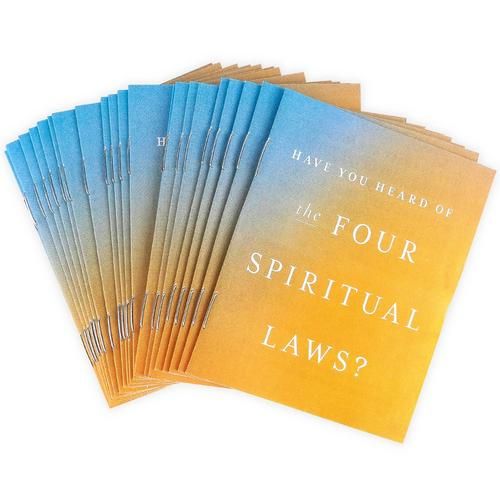
The Four Spiritual Laws is likely the most popular gospel tract ever written, the most widely distributed of all time, likely over 2.5 billion. It summarizes basic Gospel truths in four simple points:

  1. God loves you and has a wonderful plan for your life. (Jn 3:16; 10:10)
  2. Man is sinful and separated from God. (Ro 3:23; 6:23)
  3. Jesus Christ is God’s only provision for man’s sin. (Ro 5:8; 1Co 15:3-6; Jn 14:6)
  4. We must individually receive Jesus Christ as Savior and Lord. (Jn 1:12; Ep 2:8-9; Re 3:20)

The tract ends with instructions to “receive Christ” by praying a prayer inviting Him into our heart and committing our life to follow Him, assuring us that if we prayed sincerely we’re now a child of God regardless how we feel.

While each of these four laws is scriptural on the surface, the actual gospel (or good news) presented in this tract — that if we sincerely ask Christ to forgive our sins and come into our heart and save us, that He will — is not. In fact, it is so vastly different from the Biblical reality it amounts to another gospel (2Co 11:4), a false one. It distorts each of these four spiritual principles and encourages an unbiblical response to them.

While the Bible equates receiving Christ with supernatural rest in the Person and finished work of Christ (He 4:3), this false gospel substitutes a mechanical “sinner’s prayer” technique, and also incorrectly defines every key term: repentancesin and faith. It even explicitly normalizes unbelief by discounting the primary evidence of saving faith: assurance of salvation. (1Th 1:5)

The true Gospel is that Christ delivers those who believe on Him from their violations of His law: Torah. (Mt 1:21, 1Jn 3:4) As we trust Him to do so, He saves us from both the penalty we deserve for breaking Torah by dying for us in our place (Is 53:11), and He also saves us from our tendency to break Torah (Ro 6:14) by writing His laws into our minds and hearts. (He 8:10)

When God changes how we think about deliberately breaking Torah and gives us hearts fully submitted to God (repentance: 2Ti 2:25), and reveals to us that His blood has paid our sin debt in full (faith: Ro 3:25), that Father God has now made His Son Jesus Christ to be sin for us (2Co 5:21), we cannot rightly pray and ask Jesus to save us… because we will confidently know that He already has.

This supernatural knowledge will be accompanied by several significant changes within our hearts: we will love Jesus Christ (1Co 16:22); we will start obeying Torah (1Jn 3:9); pleasing God will become the most important thing to us; we will be willing to forsake anything and everything to follow Him. (Lk 14:33)

So long as any of these evidences of saving faith are not present, no one should be assured of salvation (2Co 13:5); rather, we should diligently continue seeking God, asking Him to reveal Himself to us and give us repentance to acknowledge and rest in the truth (2Ti 2:25) until He gives us faith and a new heart, assuring us of our eternal safety. (He 11:6) We should strive to enter the narrow gate into salvation (Lk 13:24), examining ourselves and systematically proving it to ourselves (2Co 13:5), diligently making our calling and election sure (2Pe 1:10), until doubting our salvation the tiniest bit is entirely foreign to us. (1Jn 5:13)

But this tract, rather than encouraging us to wait on God until we experience this deep, supernatural, inward change in what we are trusting in as the basis for our salvation, shifting entirely away from dependence on ourselves and our own works to the finished work of Christ — which is the only act that can save us, and experience how this change in our faith system is transforming our hearts to love and obey Christ from the moment this first appears within us, we are told we are now a child of God even if our beliefs about Christ and salvation have not changed and we feel no different since we started reading the tract.

In other words, this gospel assures us of eternal life simply because we asked for it, regardless what we actually believe or how we feel. This teaches us to depend on the act of praying sinner’s prayer for our salvation rather than on Christ Himself and His finished work, and it positively affirms the reality of our salvation even if we have no evidence of this faith at all, no true faith in Christ.

So, what this tract is actually doing is inoculating us against the true Gospel by offering us false hope of Heaven based upon our own work: our act of sincerely praying the sinner’s prayer.

This framing of the Gospel implies Christ has died for everyone but that His death saves no one, that believing on and resting in the atonement of Christ is insufficient, that faith does not save us, that we must do something else besides believe.

The message effectively presents Christ’s sacrifice as ineffectual: not actually saving us as we believe, only making it possible for us to save ourselves by deciding to pray the sinner’s prayer and “receive Christ”. So, in trying to distill the Gospel for us, it explicitly denies Christ’s atonement as the divine act which saves us when we rightly receive Christ and believe on Him. (Jn 1:12-13)

While presenting Jesus as the only bridge to God, this false gospel lies to us about how we cross this bridge; it deceives us about how Christ truly accomplishes our salvation: by dying for us as we believe in Him and manifesting the reality of this faith in our hearts. It leads us up the path to the narrow gate (Mt 7:14), offers us a cheap substitute for entering in through this gate, and then turns us away, assuring us we have entered in and that all will be well as we continue on down the broad road to destruction. (13)

There is only one true Gospel; trusting any other gives false hope of Heaven, which may be the most dreadful possible state we can ever be in — thinking we’re eternally safe when we’re not. God’s curse upon those who willfully participate in such deception is evidently just. (Ga 1:8-9)

After so many millions have been misled by this shallow, evangelistic travesty, is it any wonder Christ Himself prophesies of the many who will come to Him expecting open arms, only to hear Him say, “I never knew you. Depart from me, you who practice lawlessness.” (Mt 7:22-23)

articles    blog

The Father Seeketh

As Jesus teaches us about the Father, He reveals a Seeker of worshippers: God’s looking for those who worship Him in spirit and in truth (Jn 4:23-24); true worship is about relationship, loving and enjoying God Himself, not religious form or ritual.

However, this isn’t the same as indulging our emotional impulses; seducing spirits imitate the Holy Spirit and draw careless, uninformed worshippers away. If we aren’t focused on and enjoying Father God as He has revealed Himself, we’re wandering astray, off on our own path (Is 53:6), chasing idols. (1Co 12:2)

So, we should carefully heed Christ’s observation that most worship is ignorant: “Ye worship ye know not what: we know what we worship: for salvation is of the Jews.” (Jn 4:22) Unless we know God from a Hebraic perspective our worship is in error, misguided; Jesus and His followers worship in truth because they have a Torah-based mindset. The Jews are the conduit of God’s offer of salvation to the world; through the Tanakh God has revealed Who He is, what He is like and how to have a relationship with Himself. (Lk 16:29) We can only worship in spirit and in truth from such a perspective. (Ps 119:7, Is 8:20)

Christ is telling us that if we aren’t cherishing Jehovah God of the Hebrews, the God of Abraham, Isaac and Jacob, and what He has shown us about Himself in Torah, we aren’t worshipping God at all, but an idol of our own imagination. (Ro 1:21) In other words, if we aren’t meditating in the Old Testament to comprehend Divinity and how to walk with Him, if we’re getting our theology elsewhere, we’re not even in the ballpark — we’ve no idea what we’re doing.

This is the basic problem with Christian theology: in rejecting the Torah-based foundation it takes the New Testament out of context; it’s a new religion, invented well after the Apostolic era, built on the sand. (Mt 7:26-27) The Jesus offered to the world through Christianity, who abolished Torah, isn’t the Christ of Scripture (Mt 5:17-19), and the various Christianized versions of the everlasting Gospel — inasmuch as they are not grounded in Torah, are false. (2Co 11:4) It’s an elaborate counterfeit (2Co 11:13-15), and to the degree souls are inoculated with this deception the harder they are to reach.

The people of God, who are the Israel of God (Ga 6:16), understand the basics about God as revealed in Torah: Jehovah God is holy, pure light; in Him is no darkness at all. (1Jn 1:5) He is a consuming fire (He 12:29) and will trample underfoot all who err from His commandments. (Ps 119:118) It is a fearful thing to fall into His hands. (He 10:31)

Claiming to know Jehovah God without keeping His commands is lying to ourselves. (1Jn 2:4) There’s no reconciliation with God apart from obedience (Ac 5:32); God doesn’t save us to sin as we please (Ep 2:10), He writes His Laws into our hearts (He 8:10) and conforms us to the image of His Son. (Ro 8:29)

God’s followers obey Him (1Jn 3:7-8), and we do so in love — love for God and others. (10) We obey in faith, knowing God is good, faithful and true, no matter what. God works in us to live like this (Php 2:13), to serve Him with reverence and godly fear, by grace. (He 12:28)

God is seeking worshippers … who know Him as He is: Almighty Jehovah God, laying down His life to justify us (1Jn 3:16), giving us new hearts to love and pursue Him (saving us) (Ez 36:26), requiring perfect obedience of us (Mt 5:48), showing us mercy as we try imperfectly to obey (Ex 20:6) and enabling us to obey Him more and more in spirit and truth (sanctifying us). (1Co 1:30-31)

articles      blog